Our “Spotlight on…” mini-series shines a light on some of the great people we have here in our team at Gamlins Law.
Through this short series of profiles, we’ll be sharing more about our team members, including their backgrounds and what drew them into law, as well as what they enjoy about working at Gamlins.
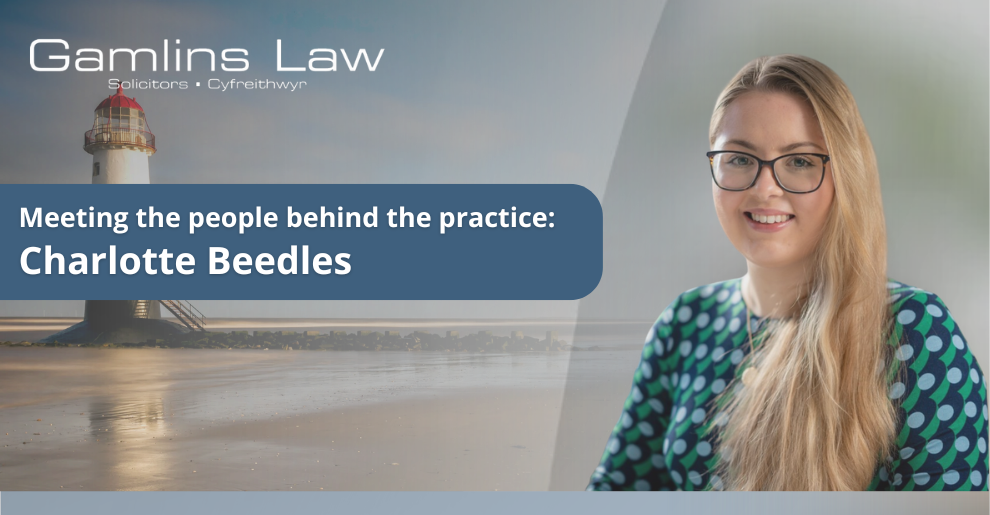
Employment solicitor Charlotte Beedles is our focus this month, who shares why she chose to practice employment law, her unusual route into the law and what she enjoys most about working at Gamlins, and in our own corner of North Wales.
What first brought you into your area of law, and what keeps you interested in it?
I first became interested in employment law during a second-year university module on discrimination, before going on to study employment law in more depth during my LPC. I liked that it is an area that affects almost everyone and sits at the intersection of business needs and individual rights.
What has kept me interested is the variety and the pace of change. It is an area that is constantly evolving, so you are always learning and having to stay on your toes, which means it never feels repetitive. I also particularly enjoy the more contentious side of employment law and the fact that advice can ultimately be tested in practice. Helping clients work through complex or sensitive issues and reach a clear, practical outcome is definitely one of the most rewarding parts of the job.
What’s something about your career path that might surprise people?
Something that often surprises people is that I did not qualify in the traditional way. The firm I trained at was not SRA-regulated, so a standard training contract was not an option for me. Instead, I initially qualified through CILEX before later cross-qualifying as a solicitor – and I still have flashbacks about completing that portfolio.
One of the real advantages of that route is that I had already been practising employment law for quite some time before formally qualifying as a solicitor. Because I knew early on that this was the area I wanted to specialise in, I was able to build up practical experience much earlier than many of my peers, which has definitely been a benefit in my career.
Who or what had the biggest influence on the direction you’ve taken?
From a young age — I decided I wanted to be a lawyer at 11 — my parents have been my biggest cheerleaders. They have always encouraged me to believe that I can achieve whatever I set my mind to, so long as I am willing to work for it, and that mindset has stayed with me throughout my career.
Professionally, I have also been very fortunate to work alongside colleagues who have not only supported me but helped to shape me into the lawyer I am today. Many of them are now close friends, and their guidance, example and encouragement have had a lasting impact on how I approach both my work and my development.
What’s your connection to North Wales, and what do you enjoy most about working here?
I’m originally from Flint, so it has been really meaningful to build my career close to home in a place that already feels familiar.
Is there a particular place, walk or hidden gem in the region you always recommend to people?
One place I always recommend is our local dog park, Cei Meadows. I have a labrador, so it has become a regular spot for us. I am also lucky to have places like Wepre Park nearby, which is ideal for a proper walk, with wooded trails and open spaces.
What part of your work do people often misunderstand until they see it up close?
People often imagine employment law is all about dramatic tribunal hearings, but in reality most of the work happens long before anything reaches that stage. A large proportion of it is advisory: advising on policies, running dismissal or redundancy processes, and helping employers or employees navigate conversations that are often already emotionally charged.
A significant number of cases are resolved through early advice, negotiation or ACAS Early Conciliation, and never make it to a tribunal hearing at all. Even where proceedings are issued, many disputes settle well before a final hearing once the legal and commercial realities become clear.
Is there a recent change or trend in your area of law that you think people should know about?
A major upcoming change is that, from 1 January 2027, the qualifying period for ordinary unfair dismissal will be reduced to six months. That is a significant shift and is likely to increase the number of claims being brought, particularly during the early stages of employment relationships. In practice, it is also likely to add further pressure to an already busy Employment Tribunal system, so delays may become even more pronounced.
What’s the most rewarding part of your job day to day?
The most rewarding part of the job is helping someone move from a place of uncertainty or conflict to a clear, workable outcome. In employment law, clients often come to you when things already feel stressful or emotionally charged, so being able to simplify the situation and give them a sense of control again is very satisfying.
What made you choose Gamlins, and what has kept you here?
I originally chose Gamlins Law because it is the biggest firm in North Wales, and that gave me confidence straight away in the quality and variety of work I would be dealing with. I had been working in Chester at the time, so it also felt like the right moment to move back closer to home and build my career in North Wales.
What has kept me here is very much the people and the work. The work is interesting and challenging, and there is a real sense that you are trusted and supported to progress. You are not boxed in, and there is plenty of opportunity to grow and take on more responsibility.
What’s something about the team culture that people might not see from the outside?
Something people might not always see from the outside is just how friendly and supportive the culture is. It is a genuinely positive place to work, and there is a really good attitude towards work-life balance, which makes a big difference day to day.
Which colleague has taught you something valuable, and what was it?
One of the best pieces of advice I’ve had was from my training solicitor, who basically said: we all learn from mistakes, so don’t be afraid of them – but if something does go wrong, tell someone as soon as you realise. The sooner people know, the sooner it can be fixed. That’s definitely stuck with me.
What’s something you’re passionate about outside work?
I have recently got back into running, which I have found really helpful for switching off mentally. There is something about not being able to check your emails when your phone is strapped to your arm that makes it a proper break. It also helps balance out my other hobby, baking.
If you weren’t doing this job, what else could you see yourself doing?
That is a really tricky question as I cannot honestly picture doing anything else. But I think I would still want to be doing something with a strong element of problem solving and working through complex issues.
If you could instantly master a new skill, what would it be?
Probably another language — or several, if I’m being greedy. It is not something that comes naturally to me, but it would be incredibly useful.
Thank you so much for sharing your thoughts and reflections Charlotte! You can find out more about Charlotte or contact her here.